salakhalimunmountain.com – When the golden glow of sunset finally vanishes behind the jagged volcanic ridges of West Java, a second world begins to stir. If you think you know the rainforest by day, you have only seen half of the story. Night wildlife encounters in Salak Halimun Forest offer a sensory journey that is entirely different from the daytime trek, as the heavy rainforest air cools and the dense canopy light is replaced by the silver shimmer of a mountain moon. To walk into the dark woods of Halimun Salak is to enter a realm where sight is no longer your primary sense. You begin to navigate by the sound of snapping twigs, the rhythmic chorus of nocturnal frogs, and the sudden, brilliant reflection of eyes caught in the beam of a torch. As a guide who has spent many midnights on these slopes, I can tell you that the mountain at night is not a place to be feared, but a place to be marveled at, where the most elusive residents finally step out from the shadows of the ancient trees.
The Golden Eyes of the Javan Leopard
The crown jewel of any night wildlife encounters in Salak Halimun Forest is a sighting of the Javan Leopard (Panthera pardus melas). This is the apex predator of the island, a master of stealth that is almost never seen during the daylight hours. At night, the leopard is the sovereign of the soft mud trails, moving with a silent, muscular grace that is truly breathtaking to behold. Their eyes, when caught in a light, glow with a haunting golden fire that speaks of a wildness we can barely comprehend. While they are notoriously shy and avoid human contact, the higher ridges of Mount Salak and the deep primary forests of Halimun are among the best places in the world to hope for a glimpse of this rare big cat.
Leopards are solitary hunters, and the night is their greatest ally. They use the cover of the darkness and the heavy rainforest air to stalk their prey, which includes barking deer and various primates. When we lead night safaris, we move with extreme caution and deep respect. We look for signs of their presence—fresh scrapings on the moss covered rocks or the distinctive shape of their pugmarks in the damp soil. Seeing a Javan Leopard in its natural habitat is a life changing experience that highlights the incredible success of the national park in providing a safe haven for the island’s most endangered carnivore. It is a reminder that in the heart of Salak Halimun, the ancient laws of the jungle remain beautifully intact.
The Slow Motion Grace of the Javan Slow Loris
One of the most frequent and charming participants in night wildlife encounters in Salak Halimun Forest is the Javan Slow Loris, or “Kukang.” These small, nocturnal primates are the personification of “slow and steady.” With their round, furry heads and enormous, light gathering eyes, they move through the vines and branches with a deliberate, cautious pace. They are most active in the secondary forests and the fruit gardens that border the park, where they search for insects, nectar, and the gum of certain trees. Unlike many other primates, the Slow Loris does not leap; instead, it maintains a firm grip on the branches at all times, making its movement almost silent.
Finding a Slow Loris requires a patient eye and a specialized red light torch, which does not disturb their sensitive night vision. When we spot one, it often pauses to look back at us, its large eyes reflecting the light like two glowing embers. In the guide to night wildlife encounters in Salak Halimun Forest, the Loris represents the gentle side of the nocturnal world. However, their cute appearance masks a unique defense mechanism; they are one of the world’s only venomous mammals. Respecting their space and observing them from a distance is essential for their safety and ours. Watching a loris go about its night, unhurried and unafraid, is a lesson in the peaceful coexistence of the forest’s many layers.
The Haunting Call of the Javan Owlet
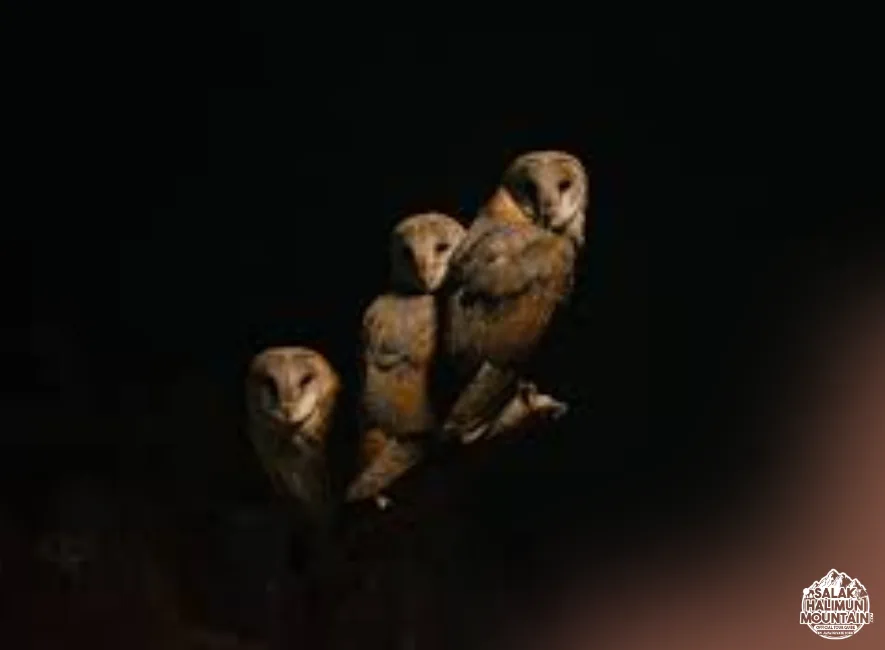
The soundtrack of night wildlife encounters in Salak Halimun Forest is defined by the voices of its birds. While the eagles and trogons rule the day, the night belongs to the owls. The Javan Owlet is a small but vocal resident that makes its presence known with a series of rhythmic, haunting hoots that echo through the dense canopy light of the moon. These birds are incredibly well camouflaged, often looking like nothing more than a knot on a tree branch. However, their sharp, yellow eyes are always watching for the movement of insects or small lizards on the forest floor. They are highly efficient hunters, with feathers specially adapted for silent flight so they can surprise their prey in the heavy rainforest air.
Owls are often regarded as the guardians of the mountain in local Sundanese folklore, and hearing their calls while sitting around a forest campsite adds a layer of mystical depth to the experience. We often use our ears to track them, following the direction of the sound until we can find them perched high in the branches of a Rasamala tree. Besides the owlets, the larger Javan Fish Owl can sometimes be found near the rushing rivers, watching the water for a silver flash. These avian encounters remind us that the sky above Salak Halimun is just as busy at night as it is during the day, filled with the beat of silent wings and the keen eyes of the night’s sentinels.
The Hidden World of Nocturnal Mammals
As we navigate the soft mud trails during night wildlife encounters in Salak Halimun Forest, we often cross paths with the forest’s smaller, busier mammals. The Javan Palm Civet (Musang) is a frequent sight, often found in the fruit trees near the forest edge. They are agile climbers and play a vital role in seed dispersal across the park. Then there is the Malayan Porcupine, a shy creature that can be heard shuffling through the dry leaves or rattling its quills as a warning. These animals are the “gardeners” of the night, constantly moving and interacting with the flora in ways that are invisible during the daytime.
One of the more unusual creatures we sometimes encounter is the Sunda Pangolin. This scaly mammal is incredibly rare and is protected with the highest level of conservation priority. Seeing one as it searches for ant nests among the moss covered rocks is a highlight of any night trek. Their prehistoric appearance and gentle nature make them a favorite for wildlife enthusiasts. By observing these mammals in the dark, we gain a complete picture of the park’s biodiversity. Each animal, from the smallest shrew to the largest civet, contributes to the complex web of life that keeps the Halimun Salak ecosystem thriving and resilient.
Bioluminescence and the Glowing Forest Floor
Perhaps the most surreal aspect of night wildlife encounters in Salak Halimun Forest is not the animals themselves, but the ground beneath your feet. In certain parts of the national park, particularly near the Cikaniki Research Station, the forest floor glows with a natural light. This is caused by bioluminescent fungi that feed on decaying wood and leaf litter. In the pitch blackness of the deep woods, these mushrooms emit a soft, neon green glow that looks like fallen stars. Walking through a patch of glowing forest is an experience that defies description, making you feel as though you have stepped into a fantasy world.
The heavy rainforest air, with its high humidity, provides the perfect environment for these fungi to flourish. Along with the mushrooms, certain species of fireflies also populate the forest clearings, their blinking lights creating a dance of gold against the dark green of the canopy. These displays of natural light are essential for the reproduction of these species, but for the human observer, they are a source of pure wonder. It is a reminder that the biodiversity of Salak Halimun is not just limited to what we can see in the sun; there is a hidden, luminous world that only reveals itself to those who are willing to explore the mountain after dark.
The Symphony of Nocturnal Amphibians
Water is the lifeblood of the mountain, and the rivers and streams are the primary stage for night wildlife encounters in Salak Halimun Forest involving amphibians. As the sun sets, the frogs and toads of the rainforest begin a symphony that can be deafening in its intensity. From the deep, bass notes of the giant river toad to the high pitched “peeping” of the tiny tree frogs, the air is filled with their calls. Many of these species are endemic to Java and are highly sensitive to the quality of the water and the heavy rainforest air. Their presence is a direct indicator of the health of the national park’s watershed.
Trekking along the stream banks at night allows us to see these creatures in their most active state. Some frogs have incredibly vibrant colors and patterns, while others are masters of camouflage, looking exactly like a piece of dead leaf or a moss covered rock. We always remind our guests to be careful where they step, as many of these amphibians rest on the soft mud trails or the low lying vegetation. Observing them up close, you can see the intricate pulse of their throats as they call for mates. They are a vital link in the forest’s food chain, providing a bridge between the aquatic and terrestrial worlds of the Halimun Salak wilderness.
Safety and Ethics for Night Treks
Participating in night wildlife encounters in Salak Halimun Forest requires a higher level of preparation and a strict adherence to ethical guidelines. The forest at night can be disorienting, and the terrain is often slippery. We always require guests to stay close to their guides and to use high quality headlamps with spare batteries. More importantly, we must minimize our impact on the animals. This means using red filters on our lights whenever possible to avoid blinding the wildlife and keeping our voices to a whisper. The night is a time of high vulnerability for many species, and our goal is to be silent observers who do not disrupt their natural behaviors.
We also advocate for the “Leave No Trace” principle with even greater intensity at night. Because visibility is low, it is easy to accidentally trample sensitive plants or disturb a nesting site. By staying on the established soft mud trails and following the lead of a local guide, we ensure that the forest remains undisturbed. Ethical wildlife viewing is the only way to ensure that these incredible night encounters remain possible for future generations. We believe that a respectful visitor is a welcome visitor in the kingdom of the night. Your safety and the safety of the animals are our top priorities, ensuring a trip that is as responsible as it is thrilling.
Essential Gear for the Nocturnal Explorer
To get the most out of your night wildlife encounters in Salak Halimun Forest, you need the right tools. A powerful headlamp is your most important piece of equipment, but we also recommend carrying a secondary hand-held torch for spotting animals in the high canopy. Waterproof clothing is essential, as the heavy rainforest air often turns into a fine mist or a light rain during the night, and temperatures can drop significantly compared to the daytime. Sturdy boots with excellent traction are a must for navigating the moss covered rocks and the occasional steep incline in the dark.
If you are a photographer, a camera with good high ISO performance and a fast lens will help you capture the elusive residents of the night without the need for a harsh flash, which can be detrimental to the animals. A pair of high quality binoculars is also surprisingly useful at night for getting a better look at an owl or a loris once it has been spotted. Most importantly, bring a sense of curiosity and a willingness to embrace the unknown. The night forest is a place of mystery and surprise, and with the right gear and a patient spirit, you will discover a side of Mount Salak that few people ever get to see.
Conclusion: Embracing the Darkness
As the first hints of dawn begin to pale the eastern sky, the residents of the night slowly retreat back into their hidden dens and high hollows. The night wildlife encounters in Salak Halimun Forest come to an end, leaving us with memories of glowing eyes, haunting calls, and the soft, green light of the fungi. These experiences change the way you look at the rainforest forever. They teach us that the mountain is a 24-hour masterpiece of life, constantly moving and breathing in the heavy rainforest air. We invite you to join us on a night trek, to leave the comfort of the campfire and step into the deep shadows. The secrets of the night are waiting for you.
So, if you’re ready to explore the wonders of Mount Salak Halimun, head over to our ONLINE BOOKING PAGE and let’s start planning your adventure. Or simply CLICK THIS LINK to chat with us on WhatsApp.
With our team, you’re not just getting a guide; you’re gaining a local friend who will ensure your trip is nothing short of extraordinary.